We host it
We run Peridot for you on Cloudflare, with your data stored in the EU. Every register only needs a browser.
- Updates and backups included
- A data processing agreement with us
- Kept running by the people who built it
Peridot is a touch register and stock system for independent shops and small chains in the Netherlands. It sells, keeps stock across your stores, runs the workshop and reorders from suppliers, and every receipt follows the Dutch rules for cash registers.
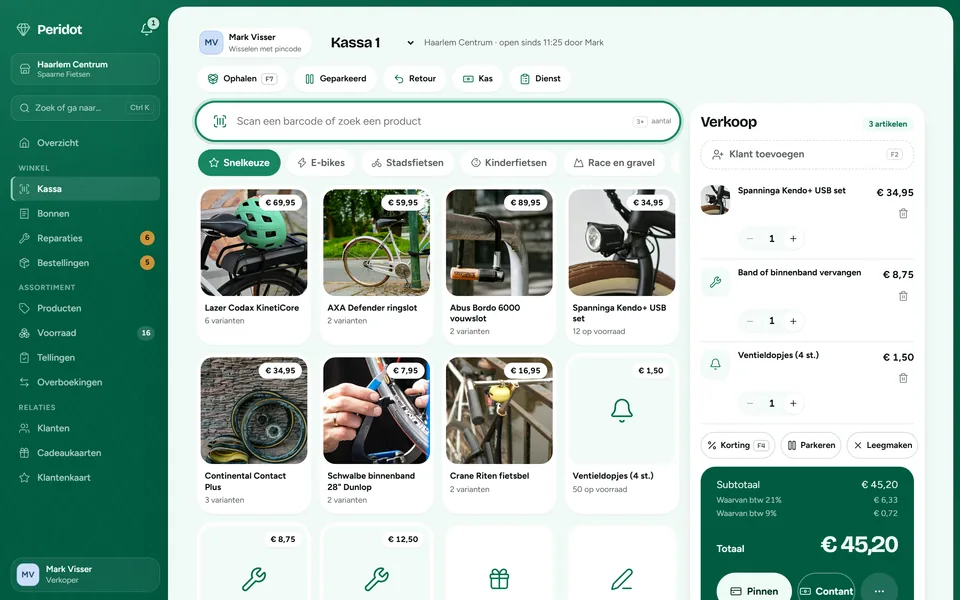
Peridot is POS and inventory software for Dutch shops with one to ten stores. This is a day in the demo's bike shop in Haarlem, as Peridot runs it.
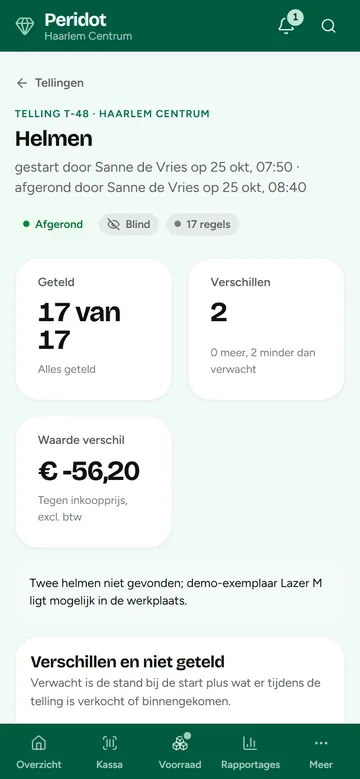
The store manager counts the helmets with a phone in hand, blind, so nobody sees what the system expects. Two come up missing, and Peridot books the difference in one go, at cost price, with a note why.
Stock counts are an optional module
The cashier counts the float and opens Kassa 1. From then on every receipt, every cash movement and every opening of the drawer belongs to this shift, and ends up on its Z-report.
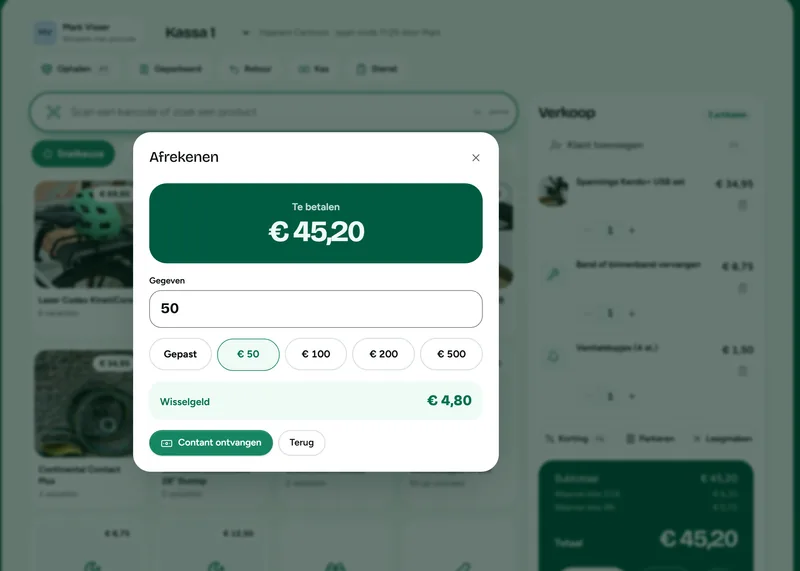
Photo tiles and quick picks, or a scan of the barcode: a scanner types like a keyboard, so it needs no driver. Pay by card, cash, gift card or points, or split a payment, and the change is worked out for you.
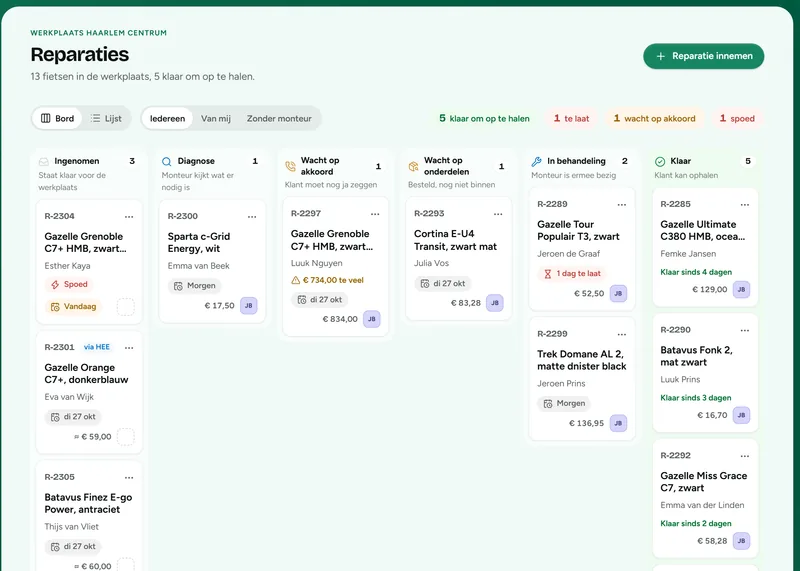
The repair comes in with the customer's approval limit and moves from diagnosis to waiting for approval or parts, to work in progress and ready. Parts come from stock, labour goes on the bill at 9% VAT, and the customer gets an email when the bike is ready.
The repairs module
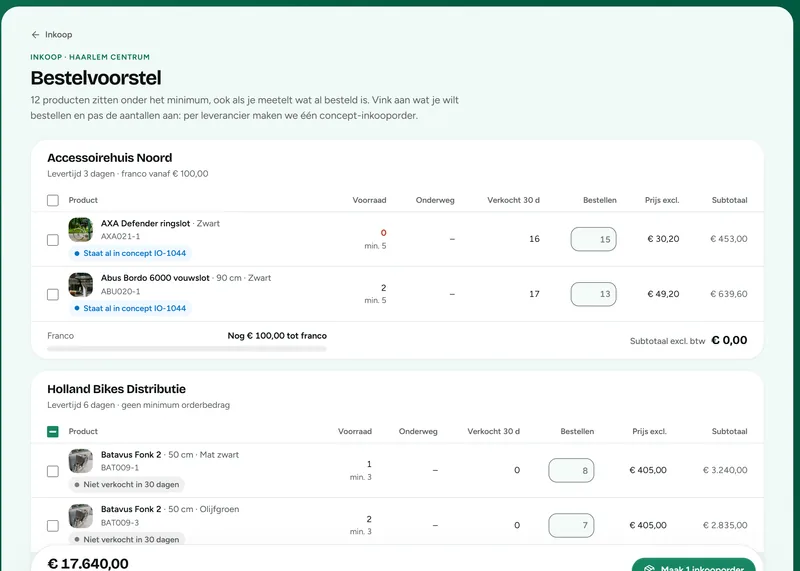
Peridot proposes an order per supplier: everything below its minimum, topped up to its maximum, with what sold in the last 30 days beside it and the supplier's threshold for free shipping. One click makes it a purchase order, sent by email.
The purchasing module
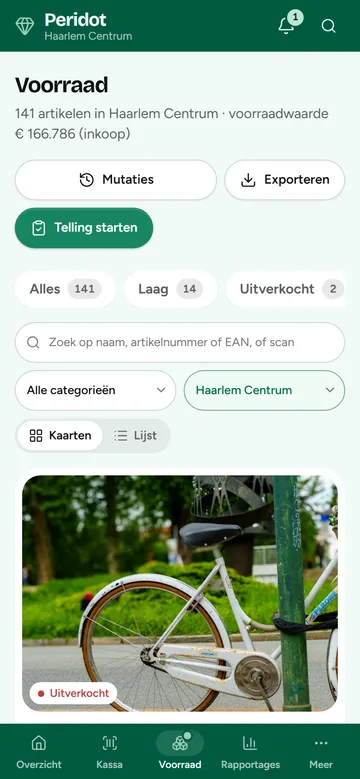
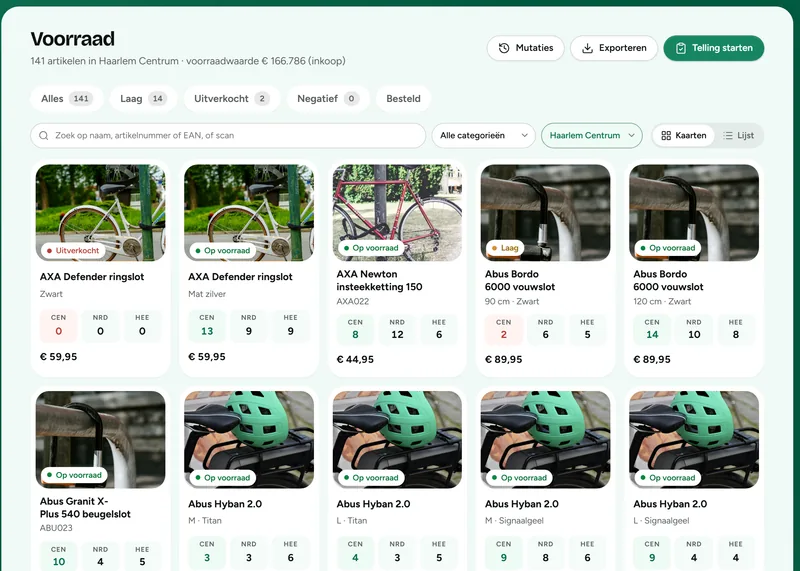
Each product shows its stock in this store and in the others beside it, with its status: low, sold out, negative or on order. Stock is a ledger, so every change carries a reason and nothing is ever overwritten.
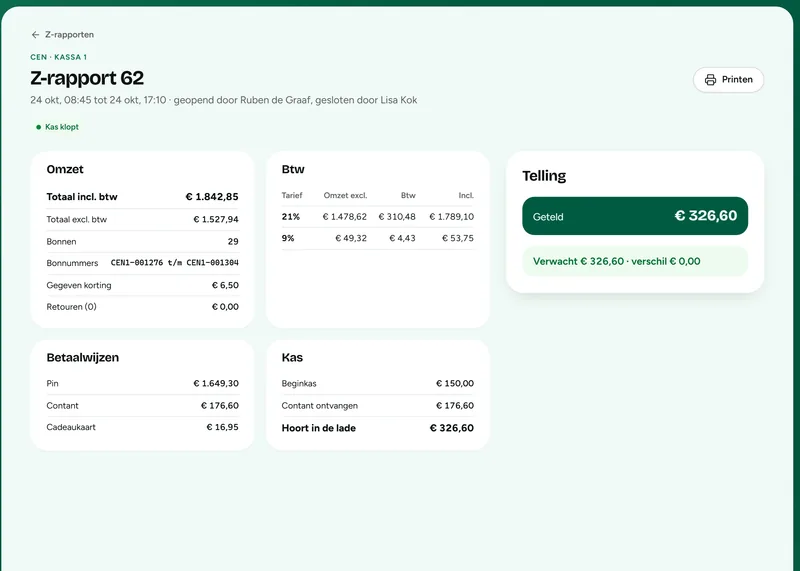
The cashier counts the drawer without seeing what Peridot expects, and only then are the two set side by side. In the demo, Kassa 1 closed after 29 receipts and €1,842.85 in revenue, with exactly the €326.60 in the drawer it should hold.
The Dutch tax authority expects a register to keep every sale and never change one. Peridot numbers each receipt and seals it with a fingerprint that includes the receipt before it, so a change anywhere would break the chain.
Each receipt carries the fingerprint of the one before.
Every register numbers its receipts without gaps, and a correction is a return on a new receipt.
A SHA-256 fingerprint chains each receipt to the last, and Peridot checks the whole chain on request.
Opening the drawer without a sale asks for a reason and goes into the log.
Close the day with a blind count, and explain any difference before the Z-report is final.
Rounded to 5 cents on the cash part only, and no cash payments of €3,000 or more.
A was-price is checked against the lowest price of the 30 days before, as the ACM asks.
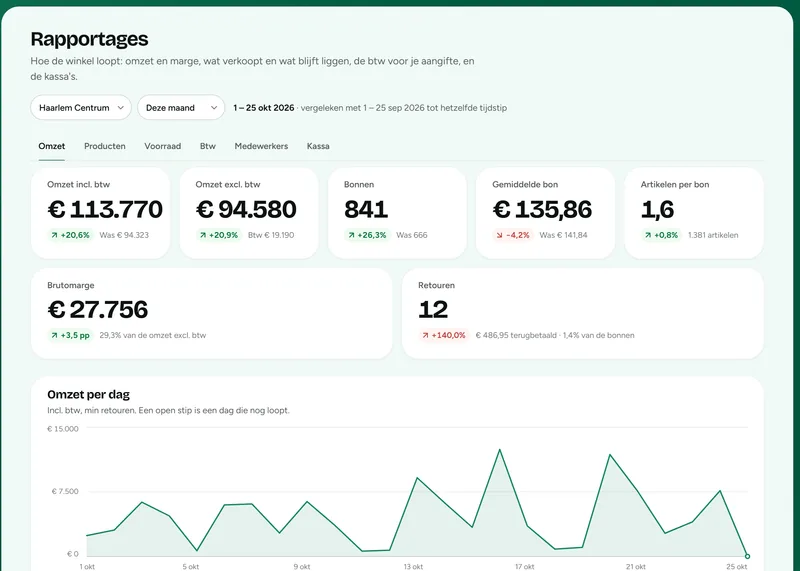
Revenue against the same days last month, the average receipt, the margin, and what sells and what stays on the shelf. The VAT return is split per box of the form, and every report exports to CSV for your accountant.
Revenue incl. VAT
€113,770
+20.6% on last month
Receipts
841
+26.3%
Average receipt
€135.86
−4.2%
Gross margin
€27,756
29.3% of revenue excl. VAT
Peridot runs in a browser on a laptop, a tablet or a counter screen. What you plug into it is ordinary shop hardware.
Any USB or Bluetooth scanner in keyboard mode. No driver, no setup.
An 80 mm thermal printer, installed as a normal printer.
An A4 sheet of 3 by 8 labels, or a 57 by 32 mm label printer.
Opened by the receipt printer; every opening without a sale is logged with a reason.
Linked through your payment provider's cloud as part of the setup. Without a link, the cashier confirms a standalone terminal's payment on screen.
Counts, stock lookups and the workshop board on any phone, without an app to install.
In the demo the card terminal is simulated: it approves after two seconds, and an amount ending in 13 cents is declined.
The register and the stock are the core. Seven modules are optional, and an installation holds only the ones you take: the code for the rest is not in it at all.
A home screen per role: today's revenue, what needs attention, bestsellers, the workshop and the stores side by side.
Touch, scan and pay, shifts with an opening float, X and Z reports, returns and parked sales.
Every receipt with VAT per rate and its place in the journal, reprinted on 80 mm or emailed.
Variants, prices, cost and margin, price history, barcodes, labels and CSV import.
Stock per store with minimum and maximum, corrections with a reason and every movement.
Private and business customers, their purchases, newsletter consent with its date, export and erasure.
Revenue, products, stock value, the VAT return, staff and Z-reports, all as CSV.
Stores and registers, users and roles, PINs, the hash chain check and an audit log.
The workshop board, intake with an approval limit, parts from stock and a pickup receipt.
Orders and reservations with a deposit, an email when they arrive, and pickup at the register.
Suppliers, reorder proposals, purchase orders by email and partial deliveries.
Full or partial counts on a phone, blind or with the expected quantity.
Stock moved between stores, from sent to received.
Gift cards and credit notes with their balance and the amount still outstanding.
Points on what was paid, spent at the register.
The demo asks who you want to be. You get your own copy of Spaarne Fietsen, a made-up bike shop with three stores, about 70 products and nine weeks of sales. Only you see what you change. Every persona's PIN for the register is 2580.
Owner
All three stores: revenue and margins, purchasing, counts, settings and the journal.
Try
Store manager, Haarlem Centrum
Their own store: stock, deliveries, counts and cash differences.
Try
Sales
The register, receipts, customers, repair intake and orders, without cost prices.
Try
Technician
The workshop board, parts from stock and stock lookups.
Try
The same Peridot runs in both places, with the same updates.
A fixed price before anything starts, as with every project we do.
Ring up a sale, take in a repair and count a shelf in a made-up bike shop.
Try the demoTell us how many stores and registers you have, which modules you want and where Peridot should run. You get a fixed price within one business day.
Request a priceYour stores, registers and staff, your products and customers imported from your current system, the opening stock per store and your card terminal.
Your team starts selling with Peridot, and we stay on hand for questions and changes.
The price depends on three things, and you get it as a fixed quote before anything starts.
Request a pricePeridot is built on the tax authority's guidance for till systems: continuous receipt numbers per register, a journal that is never changed, every drawer opening logged, and X and Z reports. Ask your accountant to review the journal export for your business; an XAA audit file can be added if they want one.
No. The demo is a bike shop because it uses everything: variants, frame numbers, a workshop and reservations. Peridot suits any independent shop or small chain, and the repairs module is optional.
The register is ready for a terminal linked through your payment provider's cloud, such as CCV, Worldline or Adyen. Linking yours is part of the setup and is included in your quote. A standalone terminal works too: the cashier confirms the payment on screen.
Yes. Peridot imports products and customers from a CSV file from Excel or your old system, shows what would change before anything is saved, and books the opening stock per store.
The screens are in Dutch, because Peridot follows Dutch tax rules and uses their terms. This page, the setup and our support are available in English.
You pick one of four roles and get your own copy of a made-up bike shop with three stores. The PIN for the register is 2580. Only you see what you change, and the copy is deleted after 14 days.
Tell us how many stores and registers you have, which modules you need and where Peridot should run. You get a fixed price within one business day.